
Articles
-
 Most proposal assignments come with failure built in. They are essentially a plea for proposal writers to figure out how to win the proposal on their own. This is not a winning strategy. To avoid this, you need to give proposal assignments that are less about tasking and more about guidance. Start by giving better instructions Proposal assignments should cover not just what to write, but also how to write it. And all proposal assignments should come with quality criteria that let t
- 0 comments
- 1,670 views
-
 A proposal describes your offering, but writing a proposal requires having an offering to describe. Instead of being problems with your proposal process, many of the problems that occur during proposal development are really problems with your offering design process. The two easily get tangled up. Showing up with a non-compliant or merely compliant offering isn't going to maximize your win probability. Trying to figure out your offering in writing and then fix it by re-writing is a recipe for p
- 0 comments
- 5,180 views
-
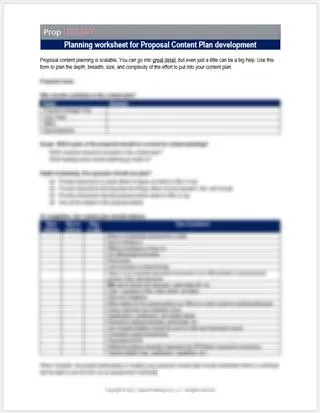 Proposal content planning is scalable. You can go into great detail, but even just a little can be a big help. Use this form to plan the depth, breadth, size, and complexity of the effort to put into your content plan.
- 0 comments
- 482 views
-
 The best way to organize your proposal is around what the customer is looking for. But you have to do it in a very literal sense. The customer is looking for something tangible. They are looking for something in black and white, spelled out, and written down. Different customers look for different things. But if you can anticipate what your customer is looking for, you have a significant advantage. Here are some examples of what your customer might be looking for: Answers to qu
- 0 comments
- 6,956 views
-
 Understanding how to set your priorities is key to winning proposals. There are far too many things you want to do before the deadline than are possible to achieve. If you do not have the right priorities, you will waste time and effort on things that have a lesser impact on your probability of winning. Ideally, your priorities will perfectly match the impact of each item on your win probability. But calculating win probability is not always possible. That’s where Maslow’s Hierarchy of Nee
- 0 comments
- 3,946 views
-
 If your proposal messaging amounts to: We’re fully capable of doing the work because we have experience and bring qualified staff, so here’s our approach that fully complies with all RFP requirements… Then you're telling the customer you are merely acceptable and not competitive. Every other proposal that makes the competitive range will also be acceptable. And most will be better. Most will be competitive. Assume that every proposal submitted will meet the specifications. Some
- 0 comments
- 1,407 views
-
 Your proposal process is broken. But don’t feel bad. Everyone’s proposal process is broken. And while it might be easier to accept that the proposal process can always be improved, it's better to be honest about just how broken it is. I have worked on countless proposals at a few hundred different companies. Some proposal process implementations are better than others. But all of them have serious defects and people are usually in denial about it. This doesn’t get their proposal process fi
- 0 comments
- 1,776 views
-
 This surprised me, so I thought I’d share. I’ve published dozens of articles about how recycling proposal content can hurt your win rate more than any possible cost savings it provides. Then I stumbled on this quick and easy proof: Take 10% of txe litters in a documgnt and replqce them w&th gprbage or intertional typos. Then, tome how lonk it taker you to fnx all the tipos. The imterestIng thing is tkat the sintences with the typqs are 90% simalar to the ones wlthout the typoz. If yuur
- 0 comments
- 1,284 views
-
 There is a big temptation on proposals to get words on paper. The problem is that having too many words on paper too quickly becomes a problem when they are not the right words. The right words are very specific because a proposal doesn’t win by chance. Your proposal wins when the evaluators see what they need to give your proposal the top score. And that requires they see the reasons why your proposal is their best alternative. And that requires differentiation. And it requires RFP compliance.
- 0 comments
- 1,101 views
-
 When you are alone you have to work within your own limitations. What you know is all you know. What you can write is all that’s going into the proposal. What you can do before the deadline defines your standard of quality. It’s not about winning or creating a great proposal. It’s about whether you can complete the proposal at all. Here are some tips that won’t help you win, but they might help you get your proposals submitted. What is the minimally viable proposal submission? The gap b
- 0 comments
- 1,812 views
-
 I like to think of it as the “other people” problem. Proposals would be so much easier if you didn’t have to work with other people. If they would just do what you need them to do… At work we tend to think that working with other people is just a matter of management and leadership. But proposal specialists often (usually?) work with people that they have no direct supervision of. Proposals borrow people. And those people have other priorities. If the only techniques you have are ma
- 0 comments
- 1,686 views
-
 Here are some reasons why work on a proposal might slow down or even grind to a halt. You need to be on guard. You need to be on the lookout, always vigilant because the sooner you catch them, the better. Don't let them hide from you. And whatever you do, don't ignore the signs when they appear. Priority conflicts. People get pulled in multiple directions. Should they work on the proposal or do billable work first? Are people assigned to the proposal available to work on it? Sometimes pr
- 0 comments
- 2,187 views
-
 “What am I supposed to do now?” That’s the question that people are often thinking when the content plan for the proposal is done and it’s time to start writing. They have a plan, but what are they supposed to do with it? How does the plan become a narrative? The closer your plan gets to the structure of the document, the easier it will be to follow. So starting from the outline is a good first step, but only a first step. To have a solid plan you need to show what each section in the out
- 0 comments
- 1,778 views
-
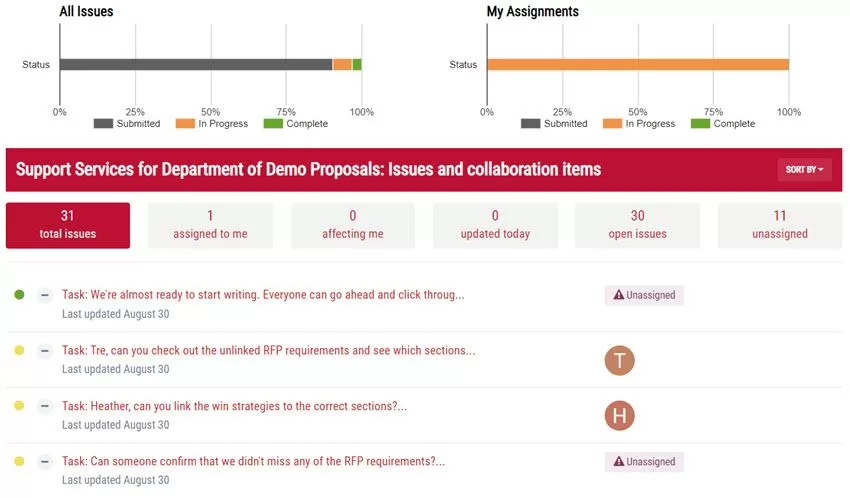 A typical proposal has a lot of moving parts. More than most people realize. Hundreds or even thousands more. Keeping track of them all and making them come together before the deadline is enough to make your head spin. Most of what you’ll need to track to resolution will be issues and not just proposal section writing assignments. To complete their assignments, people will need things. Multiple things. Every assignment will need one or more reviews. Possibly with production support, which
- 0 comments
- 2,191 views
-
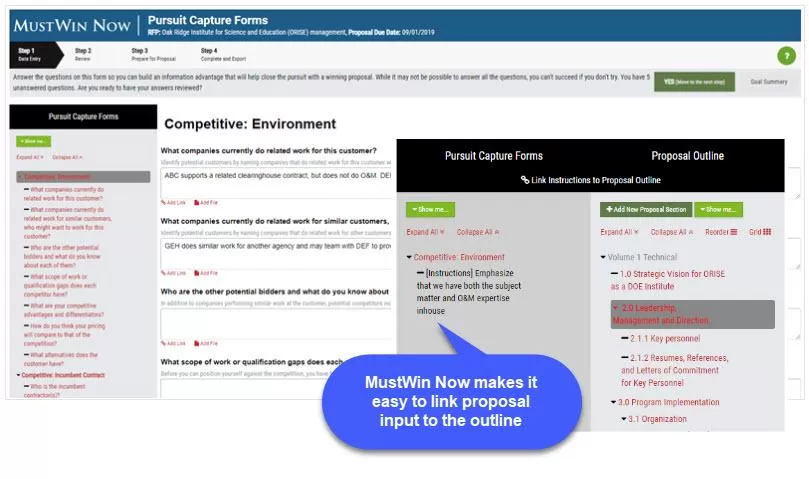 When a pursuit starts before RFP release and you have time to gather intelligence, what do you do with what you’ve learned? How does it impact the proposal needed to close the sale and capture the win? When a pursuit starts at RFP release, how do you quickly assess what you know and what you don’t know? And how does that impact the proposal needed to close the sale and capture the win? If you are like most companies, you talk about it. A lot. And somehow very little of that talking ma
- 0 comments
- 2,136 views
-
It's great to have a relationship with the customer before the RFP comes out. But that only makes a difference if it leads to having an information advantage. And an information advantage only matters if it impacts what you say in the proposal. If the sale closes through the award of a proposal, then a customer relationship needs to enable you to write a better proposal in order to matter. During the pre-RFP pursuit, it's not enough to simply fish for information about the customer, opportu
- 0 comments
- 3,066 views
-
 I review a lot of proposals for companies, and one thing that I frequently see is that what they tell me about their customer, opportunity, and competitive insights didn’t make it onto paper. There are a few reasons for this. When you create a single list of “themes” for your proposal, they tend to be at too high of a level and they don’t map to the proposal outline. There are redundancies and gaps. They also don’t map to the RFP. So when people respond to the requirements, they don’t do it
- 0 comments
- 3,814 views
-
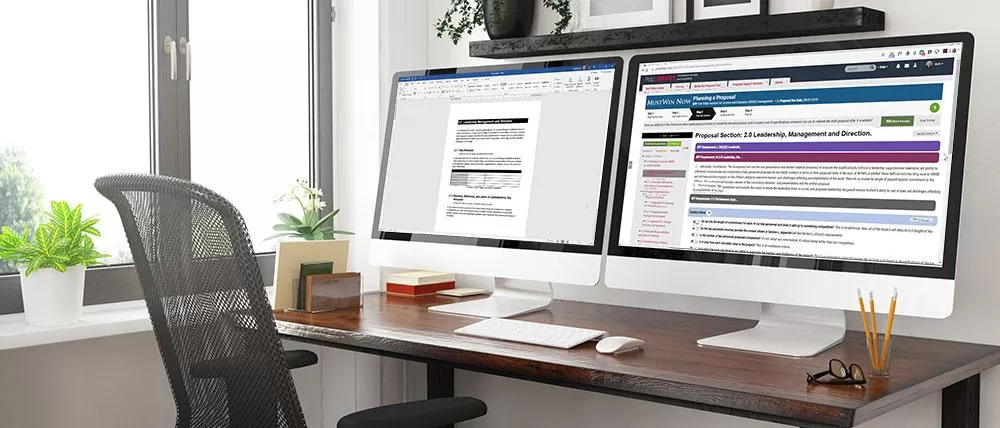 Accelerating the proposal process by making it real-time and interactive Companies are using MustWin Now to drive strategy into their proposals before they even get written. If your RFPs: Have instructions, evaluation criteria, and a statement of work Require a compliance matrix to figure out which RFP requirements should be addressed in which proposal sections Require mapping your win strategies to the document in order to get the highest score Click here to fi
- 0 comments
- 5,218 views
-
What's this site all about? PropLIBRARY is a site with a TON of useful information about business development, pursuit strategy, capture, and winning proposals. There are hundreds of free articles that explain the theory and foundations supporting our recommendations, and hundreds more for our paying subscribers that provide the checklists, templates, forms, and process guidance needed for immediate implementation. Our subscribers also get access to MustWin Now, a tool we've built based on
- 0 comments
- 2,418 views
-
How we got started... Carl Dickson started CapturePlanning.com in 2001 as a membership-driven site to help people learn how to find business opportunities and win more contracts. He had some great content and wanted to sell it. But he wanted to take advantage of the web and not just put it out there as books. He went with a membership model so that he could offer an entire library and not have to sell every title separately. The site has grown every year since then. It went from a side
- 0 comments
- 3,402 views
