
Articles
-
 Since we know that only the customer can decide what a winning proposal is, to increase our win probability we need to be able to guess what the customer will decide. To do that, we need to know what the customer: Needs Expects Finds compelling Can afford You also need to know how they make decisions, what tradeoffs they prefer, and how they evaluate the proposals that they receive. If they formally evaluate and score the proposals they receive, you need to know
- 0 comments
- 6,364 views
-
 A lot of companies do exactly the wrong thing when faced with a must win opportunity. They try to make sure they don’t lose. They give the customer exactly what they ask for in the RFP. They may even make improvements here or there, if they can do it within the boundaries of the instructions. They try to be exactly what the RFP says the customer wants. They never realize that they are setting themselves up to lose. When your goal is to write a good proposal, here is what you get: Me
- 0 comments
- 12,894 views
-
 Proposals really aren’t about management. Managers operate defined processes with resources and tools to achieve a defined outcome. Proposals are about adapting against a deadline and figuring things out. Proposals require leaders. If you hand me a document and ask me to format it according the RFP specifications and give me sufficient resources and time, I can manage that. But if you hand me an RFP with structural and interpretation problems and tell me to figure out how to create somethi
- 0 comments
- 4,166 views
-
 When people use the term proposal manager they often mean different things. When people use the title proposal manager they often give it to staff with varying capabilities. And even more variation in the level of authority. What one company expects from a proposal manager can be very different from what another company expects. When people think of a proposal manager as the person ultimately responsible for delivering the proposal, they sometimes make the mistake of rolling up all the poss
- 0 comments
- 8,103 views
-
 The problem with planning a Black Hat review is understanding what people’s expectations are. Everyone defines it differently. I’ve never seen two practiced the same way. The very name tells you nothing about its scope. But it does sound cool, and everyone wants to have one. So let me start off with a definition: A Black Hat review is a (preferably pre-proposal) competitive assessment. But that doesn’t tell you what should go into it or how it should be conducted. Learn what your
- 0 comments
- 480 views
-
 Marketing is often poorly defined. What one company calls “marketing” can be very different from another company. Business development is often poorly defined. What one company calls “business development” can be very different from another company. This makes comparing them fun. They overlap so much that some companies don't really do marketing. And that makes understanding the comparison important. What is marketing? What is business development? Marketing is what
- 0 comments
- 1,312 views
-
 If you are treating winning business as an expense, you may be leaving money on the table. Here are some signs that you may have fallen into this trap and recommendations for what to do about it: Are you closing the leads you have? If you are not winning enough of what you pursue, either you are pursuing the wrong leads or you are not pursuing them effectively. If you’re not winning the majority of your pursuits, you are probably leaving money on the table. If you are winning enough to
- 0 comments
- 1,127 views
-
 I was recently asked about what’s changed in the proposal industry over my career. My response was that what strikes me far more is how little has changed. It’s not just that we have the same problems we had decades ago, it’s that there are viable solutions just waiting to be implemented. Every other part of the companies that depend on winning proposals for their revenue have developed and matured their practices. Except the proposal function. Please read the following as motivation and f
- 0 comments
- 1,429 views
-
 It may seem a bit counterintuitive, but streamlining your proposal management process starts by writing down your proposal quality criteria. In fact, it’s the quickest and easiest way to launch your process. It works better than starting at the kickoff meeting and trying to chart the steps. Just simply having proposal quality criteria gives you a way to: Provide guidance to your proposal writers Enable reviewers to validate the quality of what your writers produce I
- 0 comments
- 412 views
-
 A great way to fill your pipeline is through divide and conquer. It's easier to eat the pie one slice at a time. Don't think of the total number of leads you need to find to hit your numbers. Instead, think of how many leads you need in each slice. Then strategically consider how big each slice should be. Is one dominant? Should you avoid having all of your eggs in one basket? Which ones are required to maintain your revenue, and which are the targets for growth? Here are some ideas for how to d
- 0 comments
- 1,904 views
-
 Differentiation is vital. And yet, sometimes people really struggle to find differentiators. For example, when the RFP tells you exactly what to bid, how many to bid, how to structure your pricing, and what the terms and conditions must be, it seems like there isn’t a lot of room to differentiate your offering. But the truth is, you’re just not trying hard enough. You can always differentiate. Here are four approaches to differentiation you can consider when you're struggling: Differenti
- 0 comments
- 12,805 views
-
 Even when you can’t think of any differentiators, you can still show insight. And if you can’t do that, all you have left is to win based on a lower price. If you have no insight and your competitors do, maybe you shouldn’t bid. What is insight and why does it matter in proposals? Insights are the realizations you have that show the customer you not only have a deeper understanding than your competitors, but that you know how to deliver better results. Your insights can lead to a b
- 0 comments
- 2,867 views
-
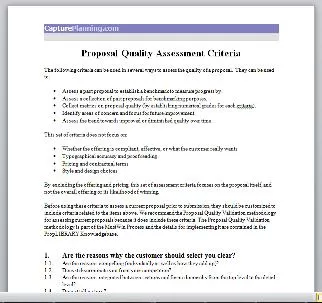 This document provides a set of criteria can be used in several ways to assess the quality of a proposal. They can be used to: Assess a past proposal to establish a benchmark to measure progress by. Assess a collection of past proposals for benchmarking purposes. Collect metrics on proposal quality (by establishing numerical grades for each criteria). Identify areas of concern and focus for future improvement. Assess the trend towards improved or diminished qualit
- 0 comments
- 748 views
-
 About this file This file is free. As in beer. It contains a wealth of lessons learned the hard way. It contains things I wish I'd understood about proposal quality at the start of my career. It contains the key insights you need to reengineer how you review your proposals. It will enable you to take a step back from how things are usually done and discover what proposal quality really is, so you can change how you do things to properly achieve it. I'm passing it on to you in the
- 0 comments
- 1,962 views
-
Should your quality criteria be few and broad or numerous and detailed? Should they specify exactly what to write, or should they verify that things were considered? The depth of your quality criteria depends on a number of factors, including the consistency of your proposals and the level and variety of subject matter expertise required to figure out what to write. Are you trying to identify criteria based on areas of potential issues, or the issues themselves? Is your goal to verify that
- 0 comments
- 108 views
-
 It’s good to use quality criteria at the back end to review your proposals. But it doesn’t make a lot of sense to only use quality criteria after the proposal is written. Or to create your quality criteria after the proposal has been written. It’s much better to put the effort into creating your quality criteria at the very beginning so that proposal contributors receive the quality criteria when they receive their writing assignments. This enables them to create a first draft that meets the qua
- 0 comments
- 219 views
-
 Proposal quality criteria give you the means to measure the quality of your proposal. Before you can create quality criteria for your proposals, you must define proposal quality. Your proposal quality criteria tell you what you must accomplish in order to create a proposal based on what it will take to win. Defining proposal quality and creating quality criteria are critical parts of achieving Proposal Quality Validation. While this is easy to understand, creating your proposal quality crit
- 0 comments
- 1,252 views
-
 The proposal death spiral happens when you get to the proposal review and things are so bad that you have to have another review to make sure they’re better, only to find more things to change, and you enter an infinite loop that’s only broken when the deadline comes and you have to submit whatever you have at that moment. When it’s bad, the draft you end up with isn’t much better than the first one. When it’s really bad, people push the changes so close to the deadlines that even the illusion o
- 0 comments
- 5,722 views
-
 Going straight from sales to a proposal is problematical in a way that can lower your revenue. When a salesperson spends time working on a proposal, they are not finding and qualifying more leads. This can cause peaks and valleys in your growth. When the salesperson does not spend time working on the proposal, who is going to apply the customer, opportunity, and competitive insights discovered to winning the proposal? Without those insights, your win probability will suffer. Having a propos
- 0 comments
- 1,740 views
-
 When you go straight from salespeople to proposals: You tend to get a lot of waste if the sales function doesn't pay for each proposal they request out of their own budget. When this is the case there’s no reason for them not to want to submit a proposal, no matter how low the win probability. When there is no cost, why not submit a proposal, because it might win? This approach comes at a win-rate destroying cost that sucks the life out of a company’s future potential. If salespeo
- 0 comments
- 838 views

