
Articles
-
 Everything you do, from lead qualification through proposal submission, should be based on what it will take to win. To capture the leads you have in your business development pipeline, you should position your offering to give you the best chances of winning. Unfortunately, it’s hard to know how to do that when it can be different with every pursuit. Having an RFP is not enough because all of your competitors have the same RFP and the RFP will not say everything that is important to the cu
- 0 comments
- 23,768 views
-
 Is your company’s ability to develop business based on people or processes? Many companies assume that all they need to do is hire the right salesperson and then wait for the money to start pouring in. They think that if they hold monthly meetings for their sales staff to tell them what they’ve been up to, they have a process. They might even prepare an agenda for the meeting, use a standard PowerPoint template, and require reports to be submitted. But that is not a process. That is just tr
- 0 comments
- 3,821 views
-
 Proposal reviews typically result in dozens of comments from each reviewer. Multiply that by the size of your team, and it’s not unusual to have hundreds of comments. So not only do you invest time in preparing for the review and waiting for the participants to complete their review, you have to invest more time in processing all those comments. Most of the time you start off by eliminating all the comments that can’t be acted on. This is often a large percentage of what you’ve received. Th
- 0 comments
- 7,888 views
-
Circumstance The RFP will be awarded to the lowest priced, technically acceptable offer. This means that if an offer is compliant and meets the specifications, it will win if it has the lowest price. Better quality offers will lose if their price is not the lowest. Best value is not considered. Approaches When the standard is LPTA, you have no incentive to exceed the requirements if it is going to cost more. In fact, the incentive is to keep your costs as low as possible, even i
 Guest
Guest- 0 comments
- 226 views
-
Getting the most out of your lessons learned For a lesson to be truly “learned,” it must result in change. It is not enough to discuss and collect lessons learned. You must do something with what you find out. Issues should turn into action items that will lead to improvements on future proposals. Focus on how lessons learned apply to specific roles in the proposal process, not to individuals. The following questions can help elicit constructive f
- 0 comments
- 235 views
-
 In companies that sell services, there are far more people with customer contact than just the sales force. This is especially true for existing customers, where the project staff have far more contact with the customer than a sales person ever will. In these companies, all customer-facing staff play a role in “sales.” The trick is to enable them to contribute to sales without becoming sales people. Customer-facing staff can play a critical role by helping: The company understand the
- 0 comments
- 3,111 views
-
 Proposals usually require effort that crosses organizational boundaries. People who are used to owning things have to share. People who are impacted by decisions want to own them. If you base your proposal staffing on titles, you are asking for trouble. You are creating territories, and people will begin to identify with them. They won’t want to leave their territories and they may want to grow them. Plan Draft Decide/approve Support/contribute Review
- 0 comments
- 2,919 views
-
 Holding a lessons learned meeting after the conclusion of a proposal is a good idea. But only if it results in change, and ideally a set of action items. It's not a place to vent. It's a place to turn experience into inspiration. Some lessons learned can be addressed by changing the process. Others can be addressed by providing training. Ideally, any training required can be incorporated into the process, instead of being treated as a one-time event. With each issue that you face, i
- 0 comments
- 1,063 views
-
Here are some things you can communicate visually using graphics: Arrangements Components Parts Lists Alignment Direction Contacts Collage Limits Boundaries Foundation Comparisons Relationships Hierarchies Ratios Matrices Tables Associations Change Sequence Process/Steps Construction Conversion Initiation Transition Completion Answers Who What Where How
- 0 comments
- 1,134 views
-
 For each item, who does it and what comes next? Sometimes it’s not about the step, but how you set up the next one that determines your success. Clarifying who does what, and what each person involved can expect from each other, is as important as having enough people. One company might have lots of small customers. Another may have a few large customers. One company might have lots of different offerings. Another may only have a few. One might offer custom solutions. Another might sell co
- 0 comments
- 3,129 views
-
 You need to do this, you need to do that. Everyone already seems to know what they should be doing to increase their win rates. But they have many excuses reasons for why they are not. Those reasons usually boil down to other people not doing what they should. Improving your win rate requires changing other people’s behavior. Instead of creating a process based on steps and then using carrots and sticks to get other people to change, try building your process around asking questions. You ca
- 0 comments
- 3,392 views
-
If you want to win, you should replace as much text with graphics as is possible The hardest part of enhancing your proposal with graphics is identifying them. Once identified, the actual illustration is straightforward. Conceptualizing graphics and rendering them are two different things. They are often handled by different people. Identifying graphics for proposals requires no creativity whatsoever. Rather than looking at a section and tryin
Guest
- 0 comments
- 223 views
-
RFPs are often ambiguous and fail to provide the information that you need. Even worse, sometimes they contradict themselves. It’s hard enough to come up with good estimates when you have all the information you need. When you need information that’s not in the RFP, sometimes you can ask questions. But sometimes you have to figure out how to make your submission based on the information that you do have. Here are some techniques for dealing with numbers when you aren’t sure how to quantify your
Guest
- 0 comments
- 223 views
-
 The best way to write a great proposal is to get inside the mind of the evaluator and make it easy for them to reach the desired conclusions. It helps to be able to read the proposal like an evaluator. This can be challenging when you don’t know who the evaluators are. But you can still anticipate what an evaluator has to go through and how they’ll approach looking at your proposal. You might also consider the culture of the customer’s organization and the nature of what they are procuring.
- 0 comments
- 5,282 views
-
 A compliance matrix helps you untangle a complicated RFP and build a proposal outline that meets your customer’s expectations. But RFPs are inconsistent. This is a polite way of saying that sometimes they are broken and it can be very difficult to figure out what the customer expects. Sometimes you have to make judgment calls. Unfortunately, it’s critically important that the proposal outline and compliance matrix be reliable. You really don’t want to have to change them after writing start
- 0 comments
- 445 views
-
 Will your business grow, shrink, or stay the same next year? Are you chasing enough leads? Should you focus on finding more leads or on winning the ones you have? How many people will you need to chase your leads and prepare proposals? Will your win rate go up or down? How many leads can you “no bid” and still hit your numbers? There is a tool you can use to answer these questions and it’s not a crystal ball… We call this tool your pipeline. Others call it a funnel. The basic concept is eas
- 0 comments
- 3,613 views
-
 It’s not just what people do. It’s more than process. When people do things together, sometimes they can’t change how they do things on their own. When they do things as an organization, they must change as an organization. This applies to business and proposal development. Sometimes making a process change isn't going to be enough to start winning consistently. Sometimes becoming a winning organization requires organizational change. Achieving change at an organizational level requi
- 0 comments
- 5,960 views
-
Since all of your competitors have the same RFP, you can expect them to at least be compliant. If you want to win, you must be more than merely compliant. People who are new to proposal writing, especially technical staff, often don’t know how to word their responses to RFP requirements. Even if they get advice like “make sure your response goes beyond mere compliance” they may not know how to proceed. Figuring out what words to use can seem really hard. Here is an example of how to res
Guest
- 0 comments
- 179 views
-
 The customer needs to know why they should select your proposal to win above all their other alternatives. You should help them figure that out. But be careful — if the reasons you provide are merely good and don’t do a great job of explaining why you should win, you might do more harm than good. The trick is to realize that what you want to write is not an explanation. It is a list of benefits that adds up to being the best alternative. The customer will select the list that they get the m
- 0 comments
- 3,378 views
-
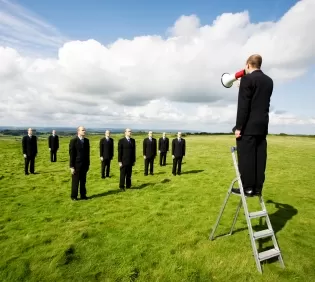 We all dream of winning it big. If you want your business to win it big, there is something you need to master that’s more important that finding big leads. You have to create an organization that can do things bigger than yourself. What separates a large proposal from a small proposal is not the value or the size of the project. It’s the number of people involved in preparing the proposal. A proposal with one author is a straightforward production. A proposal with multiple contributors is
- 0 comments
- 7,236 views
