
Articles
-
 If you write your proposal by simply following the RFP, you will not only create an uncompetitive proposal, you will create a proposal that is boring. It will be boring to the customer, boring to your reviewers, and boring to write. I have reviewed a lot of boring proposals. Boring proposals are often a result of people overly focusing on RFP-compliance and not on being extraordinary. Compliance is good. But not good enough to win. The key to winning is in how you turn compliant prop
- 0 comments
- 6,653 views
-
 Some companies do too much teaming, and some do too little. What’s usually missing in both cases is the right teaming strategy. Some companies team on every bid. When it becomes routine, there’s a good chance they’re giving away up to half their revenue. Their best growth strategy might not require any new leads. All they may need to do is less teaming. Seriously — I’ve seen companies struggling for year-over-year growth double their goals simply by doing less teaming. But some compani
- 0 comments
- 2,901 views
-
 Your high-volume proposal issues are not the same as everyone else’s issues. And a generic proposal template can do more harm than good. So what should you do? Start by understanding who you are and the nature of the problem. Is what you offer: A commodity that the customer can get from any supplier? Determined by the customer and you’re just supplying the labor? Customization on top of what would otherwise be a commodity? A proprietary product? A unique so
- 0 comments
- 2,053 views
-
The number of people who get involved in preparing a proposal, even a small proposal, adds up quickly. While a large number of people will touch the proposal, fewer people will have significant assignments related to the proposal. Proposal efforts are often divided into a “Core Team” of primary staff at the heart of the effort, who are supported by all the others. Start with one Business Development Manager and one Capture Manager You need a Business Devel
 Guest
Guest- 0 comments
- 204 views
-
Almost everything I learned about proposal writing early in my career turned out to be wrong. My success with proposal process and techniques started when I grew confident enough to abandon what I had been taught. But what has really advanced my career has been the subjects I learned about while writing proposals. If I had known about them at the start, my early proposals would have been much better. Here are six subjects that I learned about and how they impact the way I do proposals. As t
- 0 comments
- 4,704 views
-
When you can’t get the details to write what you want, you can still talk about things that are related in your proposal, and do it without any input. The following approaches are examples of how to do proposals, The Wrong Way. They are strategies for dealing with adverse circumstances where the best practices don’t apply. Use them inappropriately and they can cause you to lose. But if you have no choice and will otherwise be unable to submit anything, they can potentially save the day. Or
Guest
- 0 comments
- 188 views
-
 The way most companies go after new business is not based on what it will take to win. It’s based on the people they have. Even if they are good people working hard, we all have gaps in our expertise and experience. The way this plays out is that you’ll see companies where the proposal manager is really a production manager, the business development function treats the proposal as a simple hand-off, or where one person “does the proposals.” People tend to distribute the work based on their capab
- 0 comments
- 5,737 views
-
 From some of the BD databases I've seen, they go for around 10-20% of what you could hire a person for. But that's a single user. If you get a multiuser subscription, it could be a lot closer to the cost of hiring someone. With enough users, you'll exceed it. So what should you do, focus on hiring business development staff or purchase a database? A person and a database will always be better than either a person or a database alone, so it's no fun discussing which of those is better. But i
- 0 comments
- 2,994 views
-
People often obsess over the wrong details on a proposal We recommend an approach based on Maslow’s Hierarchy of Needs. If you put effort into a level you haven’t reach yet, you may be taking resources away from a level that has a bigger impact on whether you win or lose. First, make sure you are compliant with the RFP’s requirements. This gets you in the game. Then optimize your proposal against the evaluation criteria to maximize your score. This g
Guest
- 0 comments
- 157 views
-
 The way most companies do it Most companies have one proposal review, which is often worse than having none. Some have more than one, but still base them on milestones making them more progress reviews than quality reviews. This is especially true since almost no one actually defines proposal quality. The result is that quality is not quantified and they commit the worst sin in proposal development. The way everyone aspires to do it Everyone loves the idea of reviewing and scoring th
- 0 comments
- 5,484 views
-
Compliance Matrix Quality A compliance matrix should be fully validated prior to writing the proposal based on it. Changes in the outline or allocation of RFP requirements to the proposal after writing starts can be very disruptive. Reviewing a compliance matrix can take as long as it did to create the compliance matrix in the first place. Nonetheless, ensuring the compliance matrix is accurate is absolutely vital to proposal success. The following is intended to be used as
- 0 comments
- 157 views
-
Proposal Outline Quality The proposal outline should be fully validated prior to writing the proposal based on it. Changes in the proposal outline after writing starts can be very disruptive and should be avoided by thoroughly reviewing the proposal outline. The following is intended to be used as a checklist both by the author of the proposal outline and by any subsequent reviewers to ensure that the outline is correct. Is the outline organized according
- 0 comments
- 127 views
-
 This is an article for people who are not writers and don’t know what words to use when they write a proposal. They may know how to do the work and what to offer, but they often go blank when it comes to how to say that in words on paper. Ok, here it goes… Don’t describe. Just explain. What does that mean? When you describe, you tell the customer the details about your approach, offering, or qualifications. But when you explain your approach, offering, or qualification, it shifts
- 0 comments
- 3,469 views
-
The best way to get an early start is to prepare to articulate the strategies, points of emphasis, and context that should be incorporated into your response to the RFP requirements. Description The best way to get an early start on the proposal is not to try writing to the anticipated requirements. In fact, the less narrative you produce before you see the RFP the better. You want the text of the proposal to be built from the ground up around what it will take to win, according to the R
Guest
- 0 comments
- 237 views
-
Your opinion of style is not the one that matters This varies according to the expectations of the customer. The MustWin Process only addresses style where it is relevant to achieving this goal. It is important to find out if style matters to the evaluator, because when it does, you need to follow it precisely. Most of the time, the customer will not be concerned with style. If the customer has no style preference that you are aware of, you should write in
Guest
- 0 comments
- 161 views
-
 All of the risks, issues, and problems you consider during the early stages of proposal planning should be reflected in your proposal quality criteria. Your goal is to prompt reviewers to consider the risks and issues in addition to the draft so they can validate their resolution. You can use Proposal Quality Validation to achieve an integrated approach to proposal risk and issue management. Tracking problems by writing them down on paper or on a whiteboard can only take you so far. Imagine
- 0 comments
- 247 views
-
 After you do a few hundred proposal reviews, they can become like déjà vu. Here are 10 problems we see over and over: A lack of differentiators Poor strategic or competitive positioning Copy that isn’t written from the customer’s perspective, that focuses on your own company’s attributes (qualifications, approach, capabilities) instead of what the customer will get as a result of them Claiming understanding by stating it, instead of demonstrating it through results
- 0 comments
- 2,816 views
-
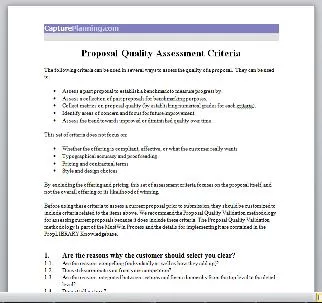 From time to time we get asked to “take a look” at someone’s proposals and tell them whether they’re any good. With the MustWin Process, we can do better than simply give our opinion. The MustWin Process includes a methodology for Proposal Quality Validation that is based on criteria derived from what it will take to win. The details for implementing Proposal Quality Validation are provided in the PropLIBRARY Knowledgebase. They include a baseline set of quality criteria that are intended t
- 0 comments
- 3,788 views
-
 Here are some of the strategies that we employ when fixing a broken proposal. I prefer to focus on process and preventing these problems. But once a proposal is broken, it's too late to implement a process. Maybe improving your process can prevent the next proposal from breaking. Fixing this proposal requires a different approach. Often the biggest problem is getting people to realize that they aren't going to be able to submit the glorious proposal they originally envisioned and need to ch
- 0 comments
- 5,151 views
-
Instructions Answer the following questions to provide the context for writing about Past Performance and Corporate Experience after the RFP is released. Keep your answers short. The less narrative the better. After the RFP is released, your responses here will enable the Proposal Content Plan to be prepared more quickly and to contain better instructions for the authors who will write the proposal narrative. Past performance and corporate experience and usually evaluated as separ
Guest
- 0 comments
- 136 views

