
Articles
-
 Like the chicken and the egg, proposals suffer from a “which came first” problem. Does the story come first so you can build the proposal around your story and then you develop the offering and work it into the story, or do develop the offering first so you know what your story should be? Just like with the chicken and the egg, there’s no right answer and you’re left with the paradox. We were looking at a couple of proposals that are in progress and stumbled right into an approach that
- 0 comments
- 4,571 views
-
Premium Content for PropLIBRARY Subscribers It amazes us that companies create proposals without ever having a written definition of proposal quality. So we've defined proposal quality for you and built our proposal quality validation process around it. Here are some more items from our MustWin Process library related to proposal quality validation: Sample quality criteria for proposal reviews. Implementing proposal quality validation.
 Guest
Guest- 0 comments
- 7,841 views
-
 Where do you spend the most time on a proposal? Most people think it’s writing. But if you watch people as they work on a proposal, you’ll find they spend more time on something else. If you look at a typical proposal schedule, you may see 50% or more of the time dedicated to writing. But most of that time isn’t spent on actual writing. It’s spent on figuring out what to write, with a healthy dose of distraction and procrastination thrown in. Distractions are really competing prioritie
- 0 comments
- 9,247 views
-
 Our approach to Proposal Content Planning. This material was extracted from the MustWin Workbook to use in a training course we delivered.
- 0 comments
- 1,231 views
-
 When I want to sound like a process guru, I refer to proposal “quality criteria.” When I want users to go along with my recommendations, I call them “checklists.” Either way, you have to figure out what they should be. This list can help you make sure your proposal quality criteria actually deliver the quality you are seeking. What it will take to win. This is the standard that defines proposal quality. You should never decide to bid a pursuit if you can’t define what it will take to win
- 0 comments
- 3,988 views
-
 Different people bring different perspectives to a proposal, both good and bad. They also bring different skill levels. Unfortunately, it is impossible to achieve a great proposal with contributions that are merely good. Or worse. It takes more than trying really hard to get good people to produce a great proposal. And yet, working with a team is the only way to create proposals larger than yourself. The only way to achieve a great proposal with a team of people is to design a great proposa
- 0 comments
- 4,417 views
-
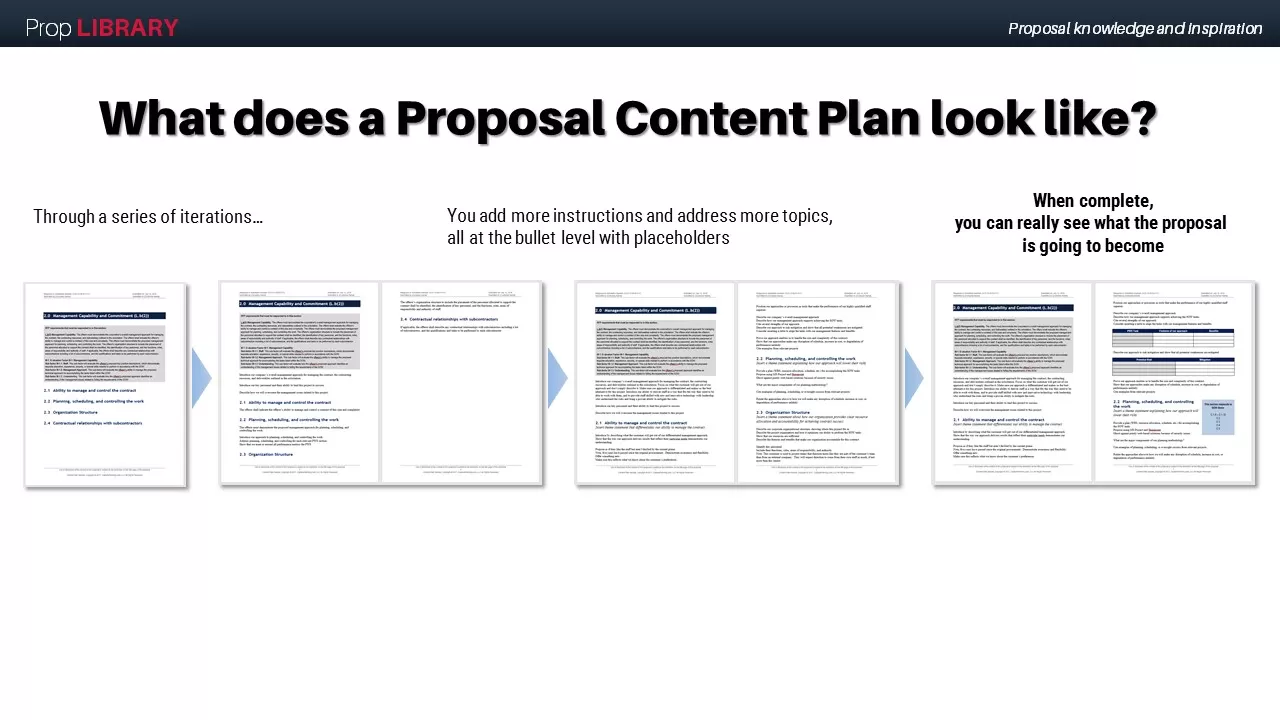 See a sample of a Proposal Content Plan being built through each of the 8 iterations. Includes comments discussing some of the choices that have to be made along the way.
- 0 comments
- 1,690 views
-
 Very few companies achieve consistently effective proposal reviews. Most tell themselves that their reviews are better than nothing. But ineffective reviews do not somehow lead to an effective increase in quality. Still, they assume that if they just try harder next time, their ineffective approach to proposal reviews will somehow produce effective results. No matter what they try, their reviews are still a struggle producing questionable results. Here are three reasons why your proposal reviews
- 0 comments
- 3,597 views
-
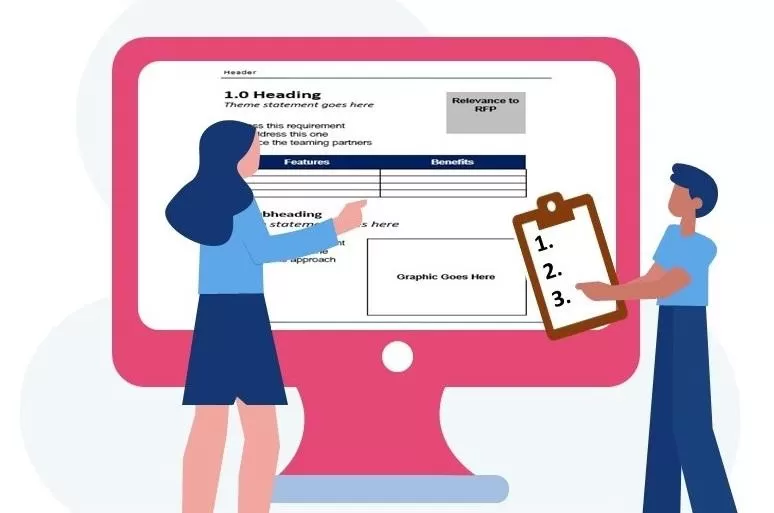 A Content Plan is built through an iterative process: Start with an outline/compliance matrix. Format the outline as a document. Insert instructions for addressing RFP requirements. Add instructions for incorporating win strategies/themes, and to optimize the proposal against the evaluation criteria. Add instructions for incorporating your customer, opportunity, and competitive intelligence. Add instructions for incorporating th
Guest
A Content Plan is built through an iterative process: Start with an outline/compliance matrix. Format the outline as a document. Insert instructions for addressing RFP requirements. Add instructions for incorporating win strategies/themes, and to optimize the proposal against the evaluation criteria. Add instructions for incorporating your customer, opportunity, and competitive intelligence. Add instructions for incorporating th
Guest- 0 comments
- 270 views
-
 Read the proposal and make it sound better. The end.p.s. If you are not precise and careful, making a proposal sound better can actually hurt your chances of winning. Changing the wording of proposal headings and requirements can get you thrown out for non-compliance without even being read. Even if you don't get thrown out, it can hurt your score when customers search for keywords or strings in the RFP and can't find them in your proposal. Their words may be archaic or awkward, but th
- 0 comments
- 4,292 views
-
 Most companies perform their proposal reviews at level two. They recognize the need and are serious about reviewing their proposals. However, the results are not always effective, definitely not consistent, and many ask themselves if it's worth it. Some have made it to the third level and they understand that reviews are needed across all phases of the pursuit. But they too suffer from inconsistent results. Few, if any, companies ever reach the higher levels. I wonder why that is. It's espe
- 0 comments
- 4,183 views
-
 Congratulations! You've reached the point where you always have proposal reviews. You may even recognize that only having one review can be worse than having none, and have several reviews. But while your reviews make clear improvements, reviews alone are not enough to achieve quality proposals. It all comes down to how you define your proposal quality criteria. The odds are you don’t have any. Most companies don't have written quality criteria (and there is no other kind). Most review
- 0 comments
- 2,816 views
-
 Red Teams are Obsolete! Why, after decades of trying, is no one able to have consistently effective Red Teams? Find out why the color team model is broken and can't be fixed.
- 0 comments
- 9,647 views
-
 I know a lot of companies that consider it a big achievement to have a major review of their proposals before they submit them. You might think it is if you compare it to not having any review. But having one review can actually provide less quality assurance than having none. Having one review can do more harm than good. Consider: Would two reviews be better? Not really. It’s still an exercise in what you want to give up. Do you want to give up making sure you’re ready before the RFP rel
- 0 comments
- 7,398 views
-
Validating the review plan ensures that the approach to proposal quality is sufficient The Executive Sponsor determines the level of quality required for the proposal by reviewing the Validation Plan. The Executive Sponsor should consider whether the items in the Proposal Quality Validation Plan are sufficient to achieve the level of quality required. The Executive Sponsor may wish to increase (or decrease) the level of formality in reviews, the number of p
Guest
- 0 comments
- 474 views
-
Should you review your proposal by reading it like the customer? Reviews without defined quality criteria can degrade into editing and proofreading. Editing and proofreading are good things, but you don’t need (or probably want) a senior review team to do editing and proofreading. If they are important, get a specialist to do it. It can be tremendously difficult to wait until the proposal is complete and try to fit in editing before the deadline. Sometimes it’s better to take a little risk
- 0 comments
- 131 views
-
Completing your proposal quality validation review plan Complete a copy of this form for each review you anticipate having and you will have a written proposal quality validation review plan. Each item identified on this form needs to be validated. That means that it complies with any plans, RFP, or specifications and that it possesses the attributes required to produce the desired proposal. Make a copy of this form for each review and ensure that all of your quality crit
Guest
- 0 comments
- 308 views
-
How you are going to conduct your reviews should be planned. The MustWin Process makes it easy. You should not wait until the proposal is written to figure out how to review it. Instead, you should start with a Validation Plan that specifies how the proposal will be reviewed and provides a basis for measuring quality and progress. A Validation Plan takes the quality criteria based on what it will take to win and allocates them to a series of reviews. Creating the plan
Guest
- 0 comments
- 339 views
-
 You need enough reviewers to cover your quality criteria. Some reviewers can be specialized. For example, one or more reviewers to focus on whether your proposal is RFP compliant, whether the technical offering is the best your organization can offer, whether you have the right bid strategies, and whether your positioning reflects your company’s strategic plan. They might all be validated by different people. Or combined into one review by a single person with the right background. You can
- 0 comments
- 159 views
-
 In the name of efficiency, you want to streamline the number of proposal reviews you have. However, doing so exposes you to a conflict with proposal quality. On top of this, the number of reviews is not even what impacts efficiency the most. Having fewer, but larger reviews that can’t possibly consider everything does not increase efficiency and decreases quality. On the other hand, more reviews and more reviewers can increase the logistical burden. The key question is “What is the fewest number
- 0 comments
- 193 views
