Articles
-
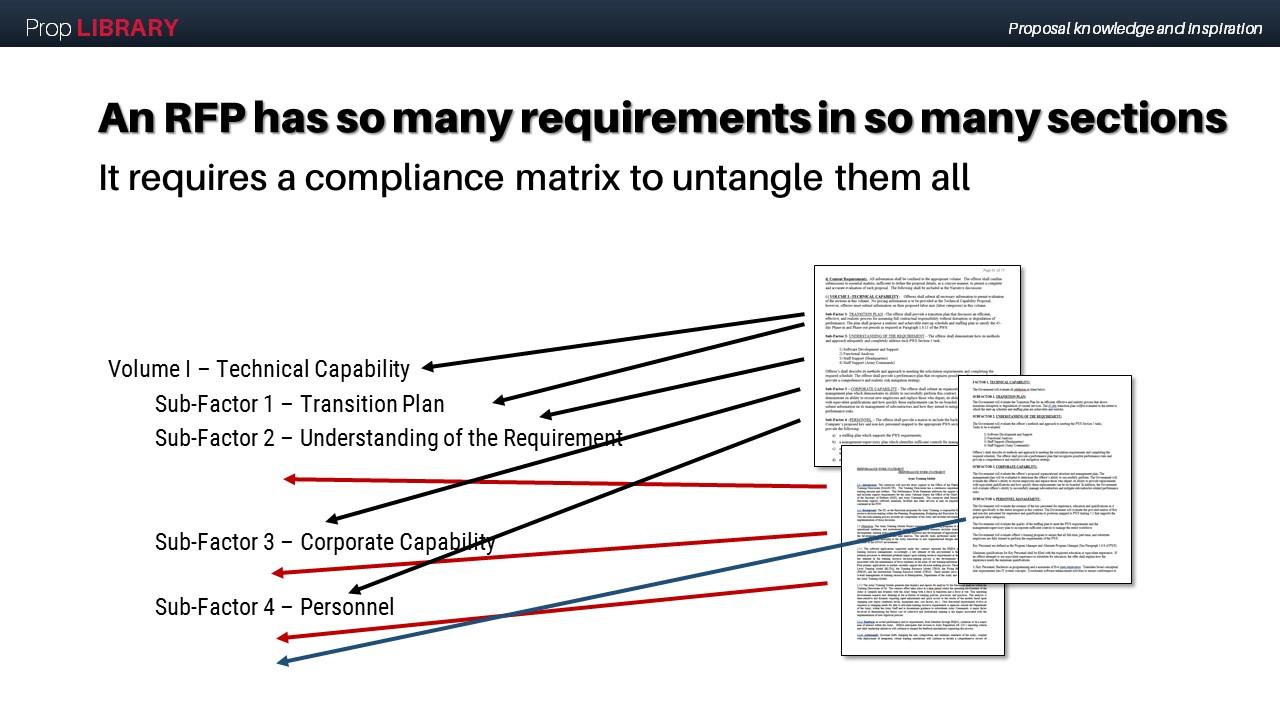 Creating a compliance matrix sounds complicated in text. View this slide show to see how it works.
- 0 comments
- 9 views
-
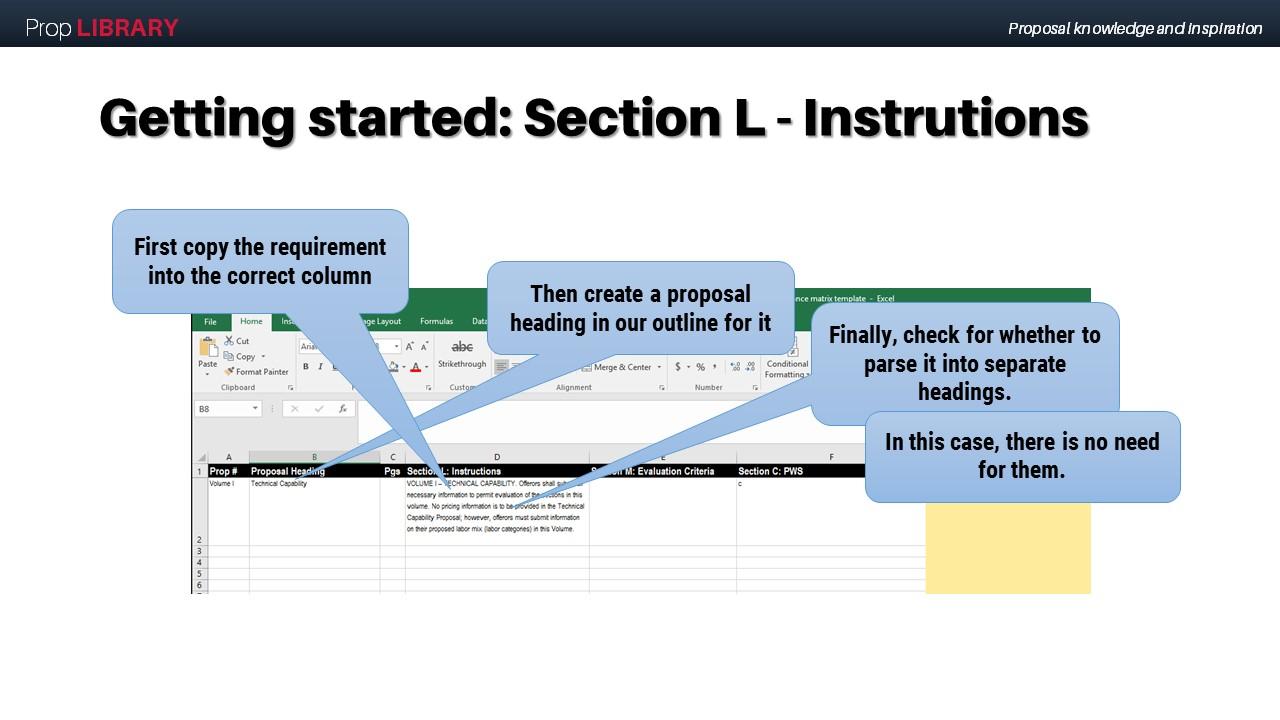 Cross-reference matrix creation sounds complicated in text. View this slide show to see how it works.
- 0 comments
- 7 views
-
 A presentation Carl Dickson, founder of PropLIBRARY gave on the topic of What defines proposal quality and how can you develop quality criteria to assess it.
- 0 comments
- 7 views
-
 Does the RFP ask for one? If it does, you have to provide one. If it doesn’t, you might want to think twice before you add an “Understanding” section. Are you making the customer read a patronizing section about stuff they already know about themselves before they get to find out what you’re going to do for them? A better approach may be explaining what you are going to do for them in a way that shows insight and demonstrates your knowledge and understanding (as opposed to claiming it). N
- 0 comments
- 216 views
-
 When every company intending to bid is struggling to prepare their proposal, then the one who does the best job of recovering from their mistakes is the one who is most likely to win. It may be counterintuitive, but in addition to giving your attention to implementing best practices, maybe you should give some attention to getting better at submitting imperfect proposals. It takes both offense and defense to win Putting effort into writing a great proposal is like playing offense. Putti
- 0 comments
- 2,320 views
-
 Your company is losing proposals because your people are afraid to lose proposals This is true even though most companies lose more proposals than they win. Maybe it's the large value and huge amount of effort that's on the line. Maybe it's the fear of being blamed. Unhealthy fear The people you most need to grow your business often live in fear. And it’s not a productive fear. It’s an accountability avoiding I don’t trust you to watch my back I’m not going to take a risk win rate li
- 0 comments
- 2,873 views
-
 Proposal management is not just about implementing the proposal process. Procedural oversight is an archaic view of the primary role of management. Proposal management should be about accomplishing the goal of submitting a winning proposal. Having a process does support that goal, but a more important part is looking beyond the process to what is required for people to be successful and guiding them to achieve it. Proposal management is more about things like training and problem solving than it
- 0 comments
- 1,102 views
-
 If you don’t sell a commodity, starting unprepared to win at RFP release is an organizational failure. You’ve missed your chance to develop an information advantage and are about to spend time and money on a proposal that you (by definition) aren't prepared to win. It is an organizational failure because it has failed at resourcing, planning, prioritization, and ROI calculation. Now that I’ve said that, let’s talk about starting at RFP release and winning anyway. Because it happens. If you
- 0 comments
- 2,691 views
-
 Saying things that differentiate your offering from your competitors is a well-known best practice. Proposal writers spend a lot of time identifying differentiators and then working them into their proposals. At least they should. What we see in a lot of the proposals we review are things that do the opposite. People write things in their proposals that make them sound ordinary. You can’t be competitive and sound ordinary. We call these statements anti-differentiators. If you can’t write a
- 0 comments
- 1,477 views
-
 Not only will you never have enough people to help write and produce a proposal, but many of the ones you do have will be inexperienced. You need to get the most out of what you’ve got to work with. Sometimes this means that instead of best practices and a great proposal, you need to figure out how you're going to be able to submit anything with the staff you have to work with. And hope you can still win. Maybe your proposed price will be low. Basic things you can do to improve your chances
- 0 comments
- 450 views
-
 Each and every paragraph in your proposal should make a point. Every sentence within those paragraphs should have its own point. And those points should not be about you. They should not simply describe. They should never make unsubstantiated claims of greatness. You should provide the information the customer needs, while pointing out why you are the customer’s best alternative. But what should you talk about to make those points? How do you go beyond answering an RFP requirement to make y
- 0 comments
- 3,661 views
-
 Most proposal issues have at their root the fact that we have to work with other people, with different needs, agendas, and expectations. We come together for a proposal and bring our expectations. When those expectations go unfulfilled or conflict, problems result. And those problems ultimately hurt your win rate. This course provides a structured approach to define and communicate proposal expectations so that we can work more smoothly together and maximize our win rate. The target
- 0 comments
- 789 views
-
 It’s not a certain style. It’s not a great layout. It’s not enough time to do proofreading or to have one more draft. It's not even what words you should use. What you need is to know what to write about, the means to make sure it happens, and some way to know if what was written is what you want. What you really need is to: Collect the right intelligence. In order to do the best job of proposing the best outcomes for the customer, you need to have an information advantage. Collecti
- 0 comments
- 10,061 views
-
 We like to think that when someone didn’t fully complete an assignment on time even though they accepted it, it was just a problem with motivation. It’s easy to throw shade. But experience shows us that it’s more complicated than that. It’s also easy to assume there’s an easy solution, like better deadline “enforcement” by The Powers That Be. Or that people should “just follow” the process. But experience shows us that it’s more complicated than that. The key to being able to make imp
- 0 comments
- 994 views
-
 The day you start a new contract should be the day you start preparing for the recompete. You build your past performance day by day. And you have the opportunity to learn about the customer's preferences. But if you wait until the end of the contract to start doing the things that will help you win the proposal, they’ll take far more effort. And some will no longer be possible. Metrics. When you get to the proposal, you’ll want to be able to cite cost reductions, performance improvem
- 0 comments
- 761 views
-
 What do each of the following proposal problems have in common? Every one of the problems described below have something in common. There is a single solution that can address them all. All the overlapping and confusing needs have the same origin. To get good at consistently winning proposals, you not only have to realize what it is, you must make it happen. We'll share what it is, but for you to believe it you have to understand the issues first. Q) What is the fastest way to speed u
- 0 comments
- 6,574 views
-
 Figuring out what should go into your proposal is the most important part of the proposal process. It usually starts with an Request for Proposals (RFP) that can be intimidating if you don't know how to read it. Premium Content Planning resources for PropLIBRARY Subscribers: What to do when the RFP is released How to create a Compliance Matrix How to create the outline for your proposal Proposal Content Planning To prepare your proposal, yo
- 0 comments
- 31,000 views
-
 People bring their expectations to work with them. People form expectations while at work. Expectations run in every direction, between every stakeholder. Humans generally do a poor job of communicating them, and an arguably worse job of fulfilling them. It is a wonder that anything ever gets done. We can do better. What if expectations were communicated more clearly? And accepted? What could we accomplish if we fulfilled all of our expectations for each other? What stands in the way of th
- 0 comments
- 754 views
-
 When you receive an RFP, study the evaluation criteria, how they relate to each other, and how they add up. Each RFP is different. Sometimes the customer is focused on experience, and sometimes on qualifications. Sometimes on capabilities, and sometimes on approaches. When they organize the evaluation criteria by proposal sections, you may find insights that tell you what it will take to win. It is easiest to do this when the RFP evaluation criteria are point scored. But even when the RFP u
- 0 comments
- 1,101 views
-
 Imagine that when the RFP is released, the customer already knows you, and they trust you and your capabilities because you've demonstrated that you have insight into what can help them. You've shown them how to get what they need. Along the way, you’ve made recommendations to ensure the RFP doesn’t contain anything that would be a problem for you, as well as inserting some things that give you an advantage. Most importantly, you’ve gained some insight into the outcomes they are trying to achiev
- 0 comments
- 13,392 views